Car Salesman Reveals The Real Reason He Wants You To Put Money Down At The Dealership—He Gets 10%
"I thought you guys made more money on financing."
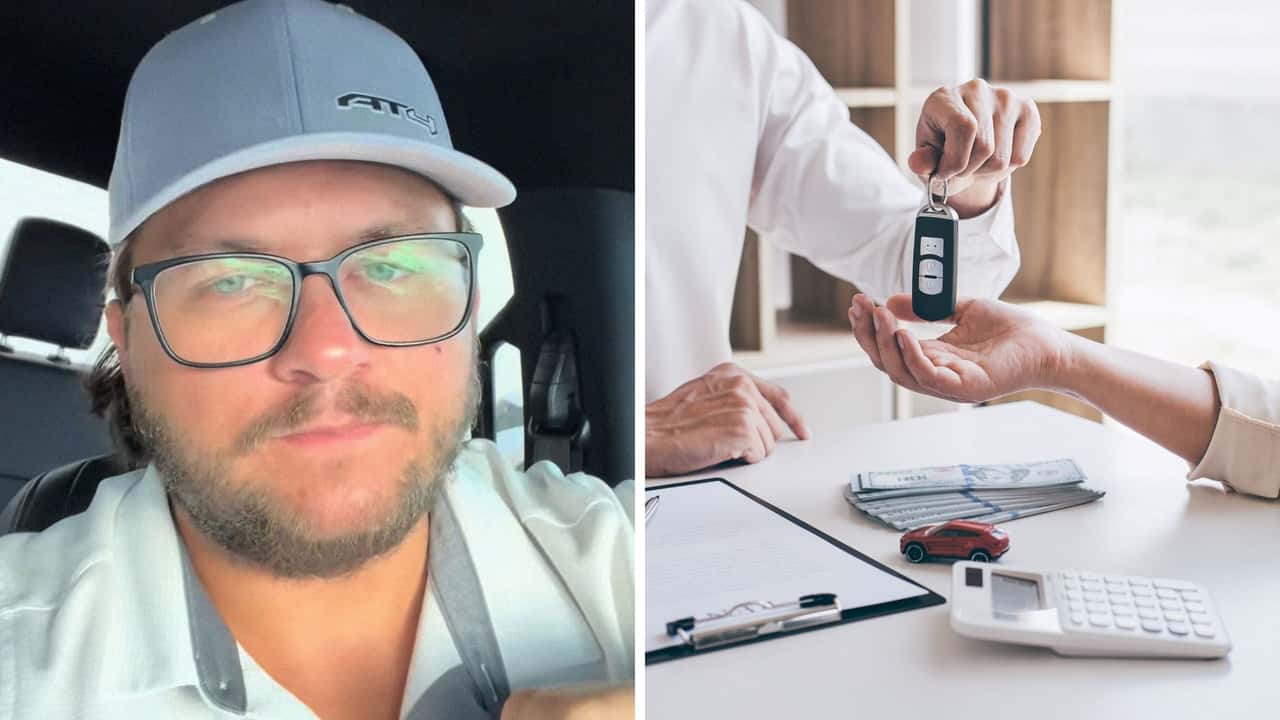

There are some car-sales stories that sound like relics from another era: the kind of old-school dealership lore that salespeople dismiss as long-gone holdovers of another time. But every once in a while, there’s one that turns out to still be true, like the Texas lot where salespeople take home 10% of the down payment on every sale they close.
A TikTok clip from salesman Iain Carpenter (@iain.sells.cars) of Brown Automotive in Amarillo, Texas, reveals how he learned from a competing salesman that the down payment compensation trick is still in place, despite him swearing for years that it was a thing of the past.
“I always said, 'No, you're crazy; that doesn't happen; that's not a thing.' I was wrong,” he said in the clip that's been viewed more than 600 times. “So, I guess there still is some car salespeople living in the '70s … taking people's down payments as a bonus and things like that.”
Discovering A Different Payday
Carpenter said the discovery came by accident. Earlier in the week, his dealership had taken delivery of a trailer full of auction cars, with nearly every vehicle on the load headed for Brown Automotive. A salesman from another dealership farther up the same street stopped by to collect one of the few cars that belonged somewhere else.
While the truck was being unloaded, the visiting salesman started comparing pay plans with one of Carpenter’s co-workers. That’s when he heard the detail that caught him off guard.
“He said that he got paid 10% of whatever the customer put down as a down payment,” Carpenter said.
Carpenter didn’t identify the competing dealership and said he knew little about the store beyond where it was located. But the conversation was enough to overturn something he had been confidently telling customers for years: that salespeople weren’t personally getting a cut of their down payment.
One viewer immediately spotted an apparent contradiction.
“I thought you guys made more money on financing, why would you encourage them to put money down?” the commenter asked.
Another viewer offered a simple distinction: “Finance makes money on financing not sales.”
That exchange gets at an important wrinkle in how dealerships operate, with money coming from a dealership arranging financing without the salesperson on the floor necessarily sharing directly in that revenue. Exactly how much a salesperson makes and which part of a deal their commission is tied to depend heavily on the dealership’s pay plan.
Gallery: Things You Should Never Say to a Car Salesman

Dealers Want Big Down Payments
As unusual as the arrangement sounded to Carpenter, versions of it are still being advertised by used-car dealers. A recent Houston “buy here/pay here” sales job listed compensation that includes 10% of the customer’s down payment, plus a $75 base payment per deal and bonuses for products such as warranties and GAP coverage.
Another Texas posting, for Del Rio Motors in Kerrville, describes a pay plan that shifts after 90 days to “10% of the down payment plus $200 per sale.”
That doesn’t make Carpenter’s competitor representative of every dealership, but it does show why pay plans can create very different incentives from one lot to the next.
There are already practical reasons for a salesperson to want a buyer to put more money down. The Consumer Financial Protection Bureau says a larger down payment reduces the amount that needs to be financed and lowers the loan-to-value ratio, one of the factors lenders consider when deciding whether to approve a loan and what terms to offer.
But a pay plan tied directly to the down payment adds another incentive. A larger upfront payment can make the deal more attractive to the lender by reducing how much money is being financed and lowering the lender’s exposure.
It also gives the dealership more cash at the start of the transaction and can make a borderline deal easier to get approved. Under the kind of pay plan Carpenter described, the salesperson benefits too: at 10%, getting a customer to put $1,000 down would mean $100 toward the salesperson’s compensation, while pushing that same buyer to $3,000 down would turn it into $300.
Carpenter told Motor1 he has worked for three dealer groups in Utah and Texas and said this was the first time he had ever heard another salesperson say their compensation was tied directly to a customer’s down payment.
At his current dealership, Carpenter said salespeople can begin earning a share of backend revenue after hitting certain sales-volume targets, with that percentage increasing as they sell more vehicles. At a previous Utah dealer group, he said salespeople received no backend compensation at all.
He said many dealerships now lean heavily on unit bonuses, flat “mini” commissions, and pay structures tied to the number of cars sold rather than a slice of the customer’s cash down.
What made the competing dealership even more surprising, Carpenter said, is that it isn’t the kind of buy-here/pay-here lot he might have expected to use an old-school pay structure.
“This is just a used car lot that’s a high-quality used car lot,” he said, adding that the dealership works with local credit unions and typically sells vehicles only slightly outside their factory warranties.
RECOMMENDED FOR YOU
GMC Driver Gets A Sensor Error On Her Yukon. Why Has It Taken Months To Fix?
2027 Jeep Compass Gets A Price Hike As Standard Features Improve
Man Borrows Girlfriend’s Car. It Only Has 1 Mile In The Tank. She Says That Means It Has 15 Miles Left
Mercedes Boss Talks Electric E-Class, Developed From A 'White Sheet Of Paper'
Expert Warns ‘Elder Millennials’ From Buying Kia Telluride. Is He Right?
Karma Teases A Winged, Track-Ready Coupe For Halloween Reveal In Las Vegas
Woman's Certified Pre-Owned Genesis GV70 Starts Pulling. Suddenly, There’s Fluid On The Floor